Fun in the mud

During our safari at Yala Nature Reserve in Sri Lanka, we encountered plety of water buffalos. May not the most exited spieces we encountered, but they made for some spectecular sights. This one enjoying a mud bath is my favourite without a doubt.

The majority of water buffalos we saw were, you guessed it, in the water somehow. Whether lying in a muddy pool, half submerged, or eating greens while wading through shallow waters, the water and the mud seems to form part of their enjoyment in life.

Water monitor

The second highlight of our river safari up the Balapitiya River in South West Sri Lanka was seeing the water monitor. We spotted it swimming towards the middle of the river, but as soon as our boat with the noisy outboard got anywhere near it, it headed back to the mangroves.

I felt sorry for the monitor, as our guide was literally chasing it back into the mangroves with the outboard at full throttle. A chased animal combined with the noise and diesel fumes of the outboard spoiled the otherwise magic encounter.

I will leave you in suspense with what the third highlights of this boat trip was.

Leopard sleeping in a tree

In this third and final part of my leopard trilogy, we see a different leopard sleeping in a tree. As some people never get to see a leopard on their Yala safari, we counted ourselves very lucky to see two leopards on ours.

We still ask ourselves the question whether this encounter was due to the sharp eyes of our tracker or his knowledge that this leopard sleeps in this very tree every afternoon. In either case, we appreciated seeing this wonderful creature hanging lazily on a branch halfway up the tree.

As you can see from the last image, the leopard was very far away from the track. The first two images are merely very small centre crops of similar images taken with my longest telephoto lens.

Leopard on a wander

In this second part of my leopard trilogy from Sri Lanka, the big male leopard sleekly wanders down from the undergrowth past a non-caring squacko heron before turning towards the water. However he decides to continue his turn and circles back to the undergrowth, likely disturbed by the jeeps gathering on the track with revving engines and tooting horns.

I am actually surprised he didn’t make a dash for it, but then again, he is probably used to the commotion of jeeps turning up daily.

Leopard emerging from the undergrowth

While on holiday in Sri Lanka we experienced our first ever safari at the Yala Nature Reserve. Although there were a few highlights our experience was very disappointing.

The safari consisted effectively of a two hour race in a jeep over rough tracks through the nature reserve, stopping just long enough on sight of some wildlife for a quick few shots before speeding off again. The question ‘did you get it?’ was followed by a swift acceleration when the answer was affirmative.

The safari felt like a race through the reserve, ensuring we captured every type of wildlife on camera. It was like going through a list of tick boxes, with the driver’s and tracker’s tip en par with how many species they could get to show us.

We were expecting a much more relaxed approach, driving to a location, staying there to soak up the atmosphere, being one with nature and seeing wildlife appear more naturally. But maybe we were expecting too much.

One of the highlight of the safari was seeing this big male leopard emerging from the undergrowth. It was heading for a drink at the pool of water, but decided to disappear back in the undergrowth, disturbed by a dozen’s of jeeps with engines roaring and tooting of horns, all vying for the best vantage point.

No wonder the leopard disappeared.
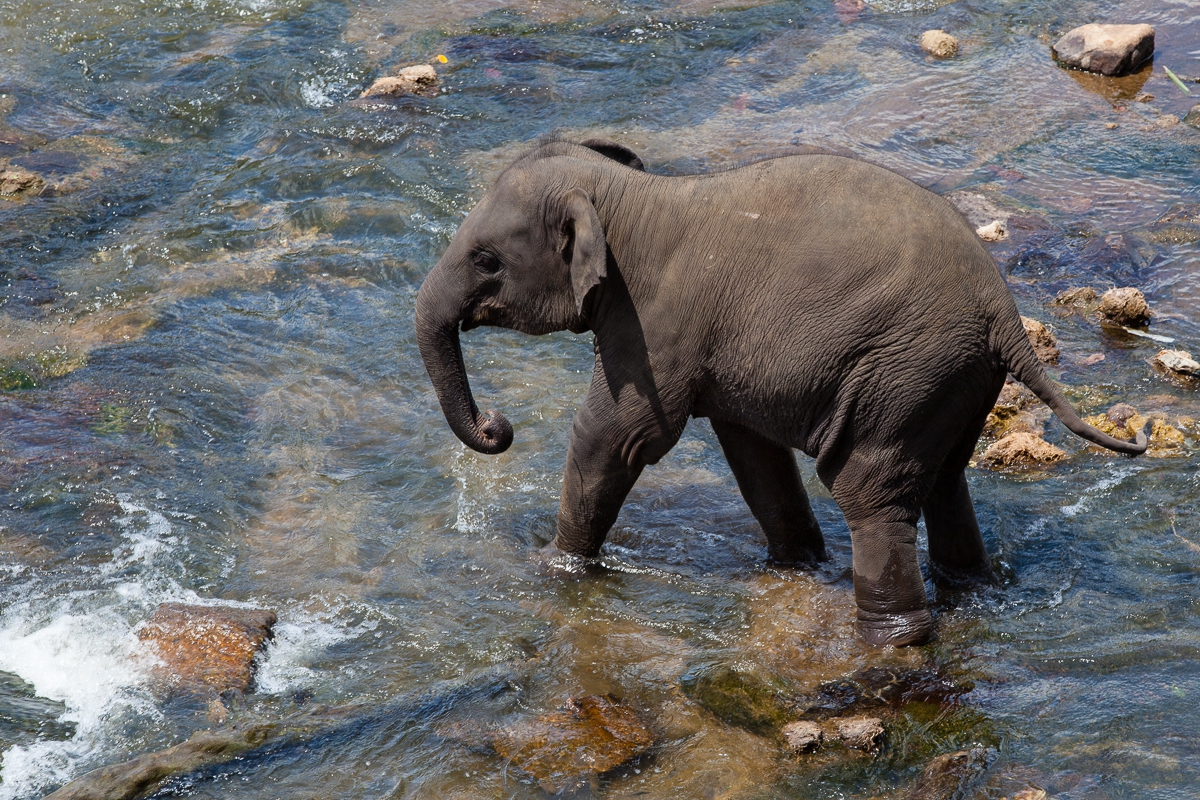
Searching for food

In this third and last post of my trilogy on wild elephants in the Yala Nature Reserve in Sri Lanka, we have a young elephant searching for food.

We watched this you elephants for a little while. It would repeatedly kick the ground, wait until the dust had settled and then search for food under the loose chunk of ground. The young elephant was closely observed by a pigeon, hoping for an opportunity to dash in and grab some insects from the freshly loosened ground.

The sequence on the right is best seen in the slideshow.

Hiding under mami

Once the two munching wild elephants had crossed the track as shown in my previous post Is it a tree?, these two mother elephants, each with a cute baby elephant followed and crossed the track shortly after.

First the mother elephant above appeared and crossed the track right before the jeep, with her baby clinging closely underneath it. Then the other mother elephant crossed the track behind us with the baby elephant following closely.

Is it a tree?

While driving along a rough track through the Yala Nature Reserve in Sri Lanka, our driver stopped the jeep beside these unusual tree trunks. Before we realised it, the tree trunk moved, grabbing a bunch of branches. The elephant crossed the track right in front of our jeep, munching away while crossing the road.

This is the first post in a trilogy of posts on the wild elephants we encountered in the Yala Nature Reserve.

The Apsara paintings

One of the most famous features of Sigiriya are the 5th Century paintings found in two depressions on the rock face some 100 metres above the ground. These paintings are a merely a fragment of an immense backdrop of paintings that once extended in a wide band across the Western rock face measuring some 140 meters long and 40 meters high.

All that has survived are the female figures preserved in the two depressions known as apsaras (or celestial nymphs), often found in religious and royal art in Asia. As so little of the mural has survived, the entire composition is left to ones imagination. The mural could well have depicted a devotional procession of the ladies of Kasyapa’s court or an expression of the cult of divine royalty with vijju kumari (lightning princesses) and meghalata (cloud damsels) at the abode of the god Kuvera.

This last image is a closeup of the centre of Sigiriya’s rock above, clearly showing the location of the Apsara paintings. There are two narrow spiral staircases leading up and down to a closed off viewing platform from the hidden traversing walkway partway up the rock face.

A scary climb, especially if you suffer from vertigo, but it is well worth it. The Apsara paintings are absolutely superb and without a doubt a must see for anyone visiting Sri Lanka.

Kingfisher

On the last day of our holiday, we went on a short river safari up the Balapitiya River in South West Sri Lanka. Not the best choice of river for watching birdlife, as the banks of the river were covered in mangrove trees. Consequently, there were no ibises, storks, herons, egrets and other waders, that we had seen in abundance elsewhere in Sri Lanka, to be seen.

The boat trip marked by a very noisy outboard and with the continuous diesel fumes was disappointing, although there were a couple of highlights. The first highlight was this kingfisher, perched on a post sticking out of the water. The kingfisher was, surprisingly, unperturbed by the noisy outboard motor, so we managed to get very close, giving me the opportunity to take a couple shots.

I will leave you in suspense with what the other two highlights of this boat trip were, as each will deserve its own post.

Views of Sigiriya

The Lion’s Rock, or Sigirya in the local tongue, is a dominant volcanic rock rising some 1,000 feet above the central planes of Sri Lanka and is distinctively visible from all directions.

Sigiriya has had a very long and turbulent history, from being inhabited in pre-historic times to becoming a Buddhist monastery in the 5th Century B.C., before being captured by King Kashyapa’s to build his splendid palace in the 5th Century A.D., and finally returning to be a Buddhist monastery after the king’s death until the 14th Century A.D. But more about the archeology, history and legacy of the Lion’s Rock in various upcoming posts.

We were lucky to witness this fantastic sunset from the terrace of the superb Kandalama hotel shortly after our arrival while sipping on a fresh mango juice. The Kandalama hotel was a fabulous experience in itself, but I will leave that also for a future post.

The next morning our guide drove us to Sigirya via the senic route, giving us the opportunity to view the fabulous rock across Kandalama Wewa. Due to the dry period, the water level in the reservoir was so low that the dead trees provided an eerie foreground to the prominent rock.

This final panorama of Sirgiriya is taken from the extensive gardens surrounding the rock on our walk in to a long but very rewarding climb to the top.

Ancient Sri Lankan door

A wonderfully preserved ancient Sri Lankan door.